
|
 |
User Adaptive Systems
User Adaptive Systems are information systems that automatically adapt to user’s needs, characteristics and preferences. As demonstrated in Fig. 1, in order to do so, two important research areas - Analytics and Personalization - play together, hand in hand, to enhance information systems in different domains such as education, business, health and others.
Figure 1: User Adaptive Systems
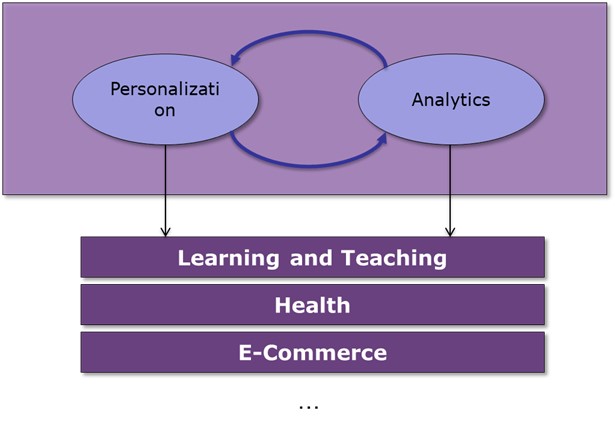
UAS research investigates how to make information systems more adaptive, intelligent and personalized. This cluster will look at disciplinary and interdisciplinary research on UAS. A major focus will be on educational technology and how to make educational systems more adaptive, intelligent and personalized but we also welcome UAS research for other domains such as business, health, psychology, gaming, and many others.
As such, this cluster includes research on topics such as:
- User Modelling and User Profiling
Research on user modelling and user profiling aims at investigating and improving the automatic detection and identification process of users’ needs, characteristics and preferences through the use of data from different sources such as sensors and user interactions with the system. Such needs, characteristics and preferences can include learning preferences/styles, cognitive abilities, motivation, affective/emotional states, and many others. While most research in this area is about the identification of such needs, characteristics and preference of an individual user, this cluster will also be interested in the identification of needs, characteristics and preferences of user groups (e.g., when working on a project together). - Context Modelling
Research on context modelling focuses on investigating and improving the automatic detection of context information such as location, items in the surrounding, and environmental context of a user, using data from different sources such as sensors of a smartphone or other mobile device, user interactions with the system, existing databases, etc. - Adaptivity
Research in this area focuses on designing, developing and evaluating techniques and mechanisms that automatically consider different user characteristics, needs and preferences in order to provide adaptive and intelligent system capacities. There are several dimensions to investigate in order to provide such adaptive and intelligent system capacities, including:- What to adapt to?
There are many different factors that a system can adapt to such as learning preferences/styles, motivational aspects, cognitive abilities, affective/emotional states, context information about a user, successful and unsuccessful behavior patterns, and many others. An interesting aspect here is not only to look into how to consider such factors but also which ones make most sense to integrate in a user adaptive system. In addition, research does not only deal with adapting to single factors but also on how to combine multiple factors to provide richer adaptivity. - How to present adaptivity?
From a technical perspective there are several ways to present adaptivity. For example, a system can (a) adapt system components, (b) recommend personalized resources and paths, (c) present adaptive interfaces, (d) provide intelligent support or (e) present individualized recommendations and advice to users in different scenarios and settings. The way in which adaptivity is planned to be presented needs to be carefully selected in accordance with the goal of the user adaptive system. - What interventions are effective and beneficial for users?
A major part in adaptivity research is to investigate and find out which interventions are effective and beneficial for a user depending on the factors that the system should adapt to. For example, how can a system help a user who has a certain learning preference, a certain motivational preference, a certain emotional state, etc.? What would be helpful for a user in such situation? - How to ensure that adaptivity benefits users?
Once an adaptive approach is designed and implemented, determining what a system adapts to, how adaptivity is presented and what interventions to make in certain situations, the approach needs to be evaluated in order to demonstrate that it really benefits users. Several different evaluation designs and approaches can be used to demonstrate the effectiveness and benefits for users. - Adaptivity for individual users versus adaptivity for groups of users
While most adaptivity research aims at supporting individual users, some research also targets groups of users. There are many open research questions for providing adaptivity for user groups such as what factors should be considered, how to create effective interventions for such factors, how to balance the needs of individual users and the group, how to ensure that individual users and the group benefits from the interventions and many more.
- What to adapt to?
- Analytics for Decision Support and Explainable Data
While user modelling and context modelling solely focuses on the identification of particular information, analytics for decision support and explainable data goes one step further and provides users with tools and systems to see such information and to dig deeper into the data to understand what the information means.
Research in this area deals with the design and development of analytics approaches, techniques and systems/tools/technologies to automatically identify and visualize a variety of useful information for decision makers (e.g., learners and instructors). Research also deals with using those approaches, techniques and technologies to increase our understanding on how users use a certain technology (e.g., a learning system) and how technology can be improved based on observed user behaviour (e.g., how do learners use courses, how can instructors teach more effectively with educational technology and how should online courses be designed to be effective). In addition, we look into how to build personalized systems to allow users (e.g., instructors) to easily access log data and dig deeper into what the data mean, using some personalized and adaptive features to make sense making easier for users.
In this research area, adaptivity is used on one hand to provide users of the developed technologies with personalized, intelligent and adaptive support. On the other hand, the data retrieved, modelled and profiled by those technologies can be used as input for user adaptive systems. - Ethics for UAS
User adaptive systems create and store sensitive data. As such, there are several concerns and questions around ethics and privacy that should be considered when conducting UAS research and developing UAS. One major question is around the ownership of those sensitive data (e.g., data about users’ needs, characteristics and preferences) and how those data can and cannot be used. Another major question is about the fairness of presenting certain content, recommendations, interfaces, etc. only to some users and not to others.
The importance of research in user adaptive systems is shown, for example, by NSERC who has identified “User adaptive systems” as one of its 21 research topics in Computer Science. In addition, there are numerous international journals and conferences in this area.
Many SCIS/FST faculty members are doing research in the area of UAS, some of them even hold major research grants (e.g., NSERC Discovery Grant) to do research in this area. In addition, the area of UAS has been shown to be very interesting for our undergraduate and graduate students since it is a highly relevant area in industry, given that topics like user modelling, adaptivity and personalization are booming in novel and current information systems. In addition, the topic brings many collaboration opportunities with industry and other faculties/departments (e.g., education, business, health, psychology, etc.).